Archive for "Activities"
Planning a trip to Italy? Browse and read our useful and informative articles about the endless range of attractions and experiences in this lovely country.
Travel through the beauties of Italy with us. Visit our blog!
Have you always had fantastic holidays, full of fun and breathtaking scenery but something has always been missing?
Do you remember the hot sand under your feet, the blue sea, cocktails while admiring a sunset, but still feel a void to fill?
Read on, we have just the thing for you.
Holidays are one of the most anticipated and desired moments, they are planned with great care and always seem to last too short.
Today we would like to offer you a different kind of holiday, one that will allow you to return home with a very rich bag of experiences (don't worry, this will pass through airport control, not like your suitcase, which will weigh several kilos more than it did on the way out).
In this article, we will tell you about the Corfu trail: a 180-kilometre route across the island of Corfu, from south to north.
The Corfu trail is a long path across the entire island of Corfu. The trail was gradually created by some friends living on the island. Thanks to the wise planning, the Corfu Trail is today one of the most famous trails in Greece. In fact, it is the only one that combines natural landscapes still unspoilt by mass tourism with urbanisation: friendly Corfiotes, picturesque monasteries, Byzantine and Venetian monuments.
You will recognise this path thanks to yellow signs placed at strategic points and marked with a C and a T together with a two-way arrow. It is advisable to follow the route starting from the south and heading north mainly for two reasons:
1. Hikers will gradually prepare themselves from the gentle south to the more mountainous region in the north.
2. The most spectacular landscapes and the greatest concentration of attractions are to be found in the north of the island.
Why do we propose this route?
Because one of our magnificent villas is very close to a path of this trial: the one called Donkey Path.
We are talking about 'Villa Prokimea'.
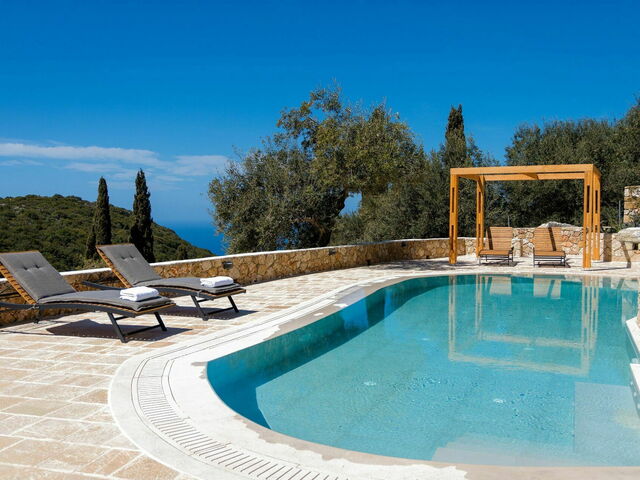
"Villa Prokimea" is a brand new and very elegant villa in Makrades, just a few kilometres away from Palaiokastritsa and Agios Georgios, lively seaside resorts.
The villa can accommodate up to six people thanks to its three modernly finished bedrooms.
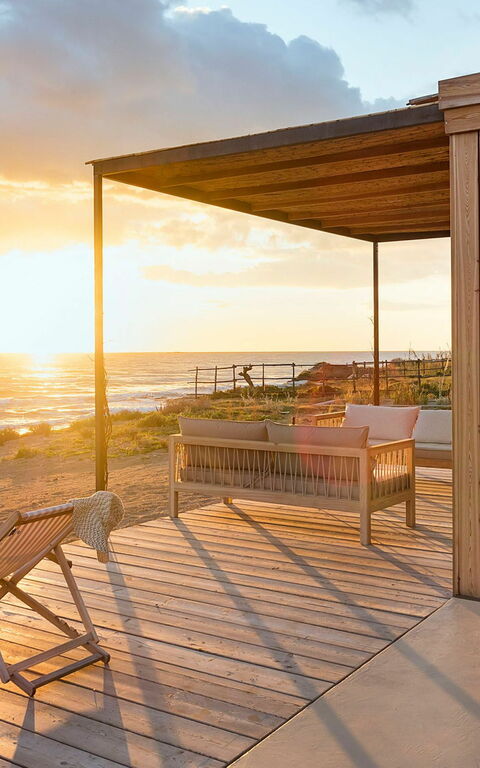
The highlight? The panoramic terraces, the swimming pool with sunbathing area and the short distance from the Corfu Trail. Just 800 metres from the villa you will find the start of this beautiful trail that will lead you to Agios Georgios, delighting you with sublime views of the turquoise bays. The 6 km can be covered either by bicycle or on foot.
Are you ready for this experience? What are you waiting for, run and book!© Rebecca Taizzani
Read More
The Island of Hvar, with its 270 km of coastline, is the longest island of Dalmatia and is located among the islands of Vis, Brac and Korcula. Its paradise beaches, unspoiled nature and millenial history played in favor of Hvar, turning it into one of the most visited and loved places in Croatia by tourists from all over the world.
If you are going to stay in Hvar and you don't know what to do, read our top 10 list of unforgettable activities and unmissable places to visit on the island of Hvar!
1. ST. STEPHEN'S CATHEDRAL
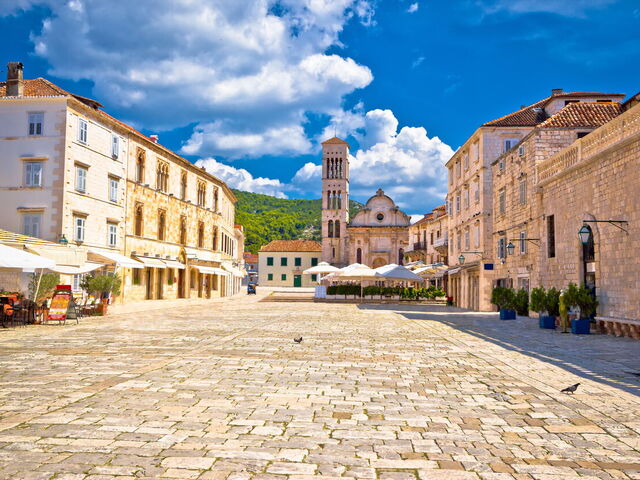
Located in the historical centre of Hvar City, St. Stephen's Cathedral is one of the main attractions for tourists. The original building was built in the XII century, but it has been demolished and rebuilt many times, until 1755 as we can see it now. The Cathedral is dedicated to St. Stephen Pope and martyr and houses three poorly decorated naves. The real beauty of this Cathedral is its frontal square: ruled by the color white, it has many bars and restaurants on its stone pavement..
Wherever you are, every road will lead you to this beautiful square!
2. THE FORTRESS
The main panoramic point is Fort Fortica, also called Spanjola. It has a huge historical value for the city, in facts it was built in the XVI century on a 100 m high tall hill under the Venetian rule and then it was used as a shelter in 1571 by the island's inhabitants when they were invaded by the Turkies. Inside the Fortress, you can find an interesting museum, but the real beauty of this place stays in its breathtaking panoramic view extending on the city of Hvar to the nearby Pakleni Islands.
3. FRANCISCAN MONASTERY
The Franciscan Monastery is a place of peace, silence and serenity. It was built during the XV century as a shelter for sailors and then turned into a Monastery. Inside, there is a rich museum which collects coins, amphoraes and books, besides several paintings, among which the most important is "The last dinner".
4. THE THEATRE AND THE ARSENAL
The theatre of Hvar has got a huge historical value: it was opened in 1612 and is one of the oldest theatres in Europe. The Teatre was built on top of the Arsenal, one of the most beautiful buildings in Hvar City., which was used as a storage of boats and other nautical materials. The Theatre hosts the Contemporary Art Gallery and is still active, especially in the tourist season.
5. BEACHES
Don't foget to visit the magnificent island's beaches! There are several beaches because, as mentioned, the coastline extends for 270 kilometres! Three marvellous beaches selected for you nearby Hvar City are Dubovica, Zarace and Milna, three charming bays where you can relax, sunbath and enjoy wonderful sunsets.
6. PAKLENI ISLANDS
Pakleni Islands are a small archipelago consisting of little islands and sea rocks. The meaning of their name is controversial: it literally means "Hellish Islands", but pakelna also means pine. In facts, these islands houses meny pines, used mainly for the construction of boats and buildings. Over a long period of time, the term paklina has been linked to the term pakao (hell) and that's how a linguistic mistake changed the whole meaning of the Islands' name. The main island is Saint Clement, that has a small village built by Egen Meneghello, a pharmacists, in 1848. In the village there is a Greco-Roman amphoraes' museum, which represents the biggest collection of amphoraes in the whole country!
Other beautiful Islands of the Pakleni Archipelago which are worth a visit are Jerolim, Marinkovac and Šćedro, where you can enjoy crystal clear water, cuisine traditions and many activities as water sports.
7. STARI GRAD (OLD TOWN)
Stari Grad is a very ancient town (its name literally means ""Old Town"") founded in 384 b.C.. It's located on the North-West side of the Island in a gulf safe from attacks, so Stari Grad was known as a strategic spot where Adriatic Sea's sailors could stop during their long trips. This town hosts every year music and sport events and is a real jewel of the Island. With its vineyards and its fertile fields it offers to its visitors excellent typical products, among which a delicious wine. Stari Grad is for sure an unmissable place during your stay in Hvar!
8. BRUSJE
If you want to see the authentic side of Hvar, Brusje is made for you. Among gardens, paths and stone walls, the silece reings. This beautiful village has been abandoned since the end of II WW, but the true Island life took place here. Populated since the 15th century by farmers and shepherds, Brusje now has only 150 inhabitants, who are involved in tourism and the production of essential oils, especially of lavender derivatives. The town is famous for its characteristic roofs dating back to the Roman era and for the Mediterranean atmosphere that you can breathe: visiting Brusje is like diving into the authenticity of the past of the Island of Hvar. Here you can visit the Church of St. George, the fish market and the retirement home of Macirovo
9. JELSA
Located in the central area of the island, the town of Jelsa is a gem not to be missed. It has indented coasts and offers its visitors an incredible panorama. It is surrounded by mountains and nature, so much so that it is home to one of the most beautiful parks in Dalmatia, Perivoj. The city has always been inhabited and visited by tourists, presenting monuments and buildings of historical, artistic and cultural interest, as well as its characteristics villae rusticae , houses built across the fields and used for rest and relaxation. Later, the same houses were used by ethnologists and herbalists as a support to carry out their research.
10. VRBOSKA
The beautiful town of Vrboska is the smallest on the whole island of Hvar. It is known as little Venice for its canals and bridges. Its architecture is made up of buildings in Gothic, Renaissance and Baroque styles and the attractions that are worth a visit are the fishermen's museum (which houses a collection of nets, fishing tools and fish processing machinery), the church and fortress of Saint Mary Grace.
What are you waiting for? Book now you stay in Hvar!
Browse our selection of villas in Hvar, like Villa Liza, Villa Mare and Villa Cvita.
Read More
July 26, 2021
Alcantara Gorges: Everything You Need to Know!
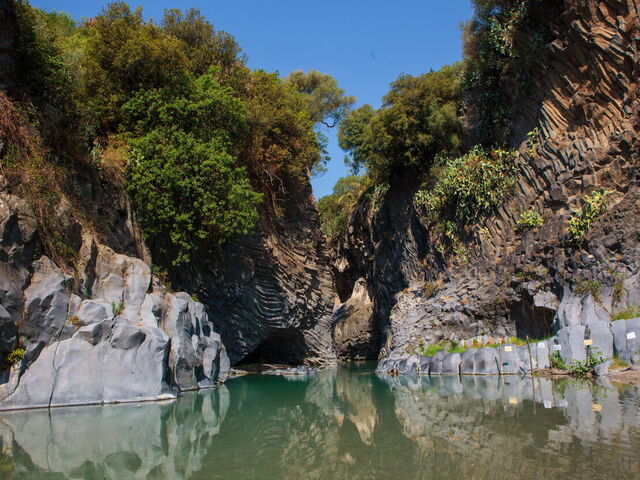
The Alcantara Gorges, also called Larderia Gorges, represent one of the most suggestive and less known place in Eastern Sicily. This paradise is located between the provinces of Messina and Catania, more precisely between the municipalities of Castiglione della Sicilia and Motta Camastra. The canyon was formed by the lava stone erosion, which took place over thousands of years by the Alcantara river, one of the most important rivers in Sicily. The most impressive and famous gorge of Alcantara is located in Fondaco Motta and is more than 6 km long, but only the first 3km can be reachable.
The lava stone walls, eroded by Alcantara, date back to more than 8000 years ago! In fact they are the result of lava flows open at that time and in more recent times as a result of volcanic eruptions, which have created overlapping different prismatic forms of the lava stone itself.
The territory of the Alcantara Gorges obtained in 2010 the European recognition of European Destination of Excellence
(EDEN).
The access routes to the gorges are different and varied: you can choose between a visit to the small gorges, the path of the Gole di Larderia and the of Montagna Grande, the path of Castiglione di Sicilia, the path of the Castello di Calatabiano or the one that runs along the banks of Alcantara. The difficulty levels are different, to give the possibility to beginners and advanced to enjoy this wonderful place.
Even if you are not an expert in walking, the Alcantara Gorges are worth a visit for its crazy panoramic views and its naturalistic landscape.
For sports lovers, the activities proposed are many. There is, in fact, the possibility of practicing canoying, body rafting, kayaking, trekking in the gorges and quad excursions. In addition, you can organize bike tours, hiking between Etna and the gorges, wine tastings and much more!
This little hidden paradise can be easily reached from our villas in Eastern Sicily, such as Villa La Boeme, Torre Isola Bella, Villa Angelina and Villa Torre Etnea.
Read More
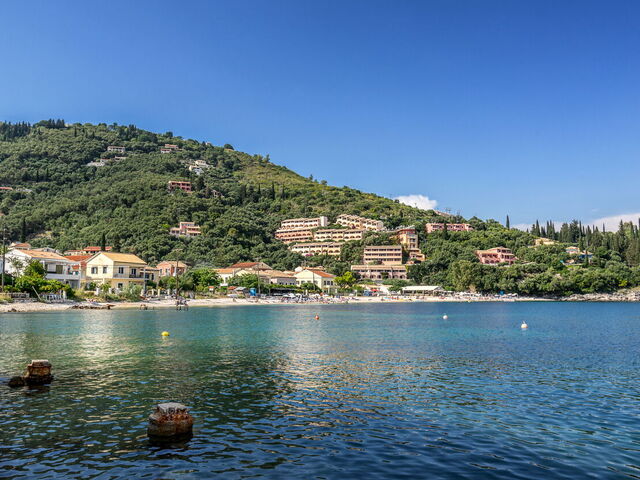
The Durrells is a magnificent TV series on air since 2017, produced by Sid Gentle Films and Masterpiece and which made the whole world discover the beauties of a Corfu of the past, when there were still no holiday villages, discos and luxurious clubs on the beaches of the island.
The series is in fact set starting from 1935, when an entire family with British origins decides to change their lives and move to Corfu. The progenitor of the Durrells, however, died during the war, so Louisa, the mother, has to face a series of events that take place between the tragedy and the comedy together with her children and the inhabitants of the island, still unaccustomed to foreigners.
Did you know the Durrells really existed? The Durrells, indeed, is the television reinterpretation of the trilogy of autobiographical books "My Family and Other Animals Birds", "Beasts, and Relatives" and "The Garden of the Gods" written by the real Gerald Durrell, a British naturalist, zoologist and explorer who lived in Corfu with his family between 1935 and 1939. Compared to the book and fiction, however, the eldest son had already moved to Corfu with his wife a few years earlier and was then joined from his family.
The house where the daily life scenes of the Durrells are filmed has become a tourist spot and is known as the "White House" of the Bay. It still exists and is super requested to stay!
The locations on the island where the series was filmed are mainly Kalami, Agni Beach, Corfu Town and Danilia, all located in the northern part of Corfu.
If you want to spend a stay in the same locations as the Durells, take a look at our Villas in Corfu as Villa di Giovanni!
SEE OUR HOLIDAY RENTALS IN CORFU
CORFU
Corfu is the second largest island of the Ionian archipelago after Kefalonia. The island is known for its lively nightlife and its dream beaches, which frame the crystal clear water of the Ionian Sea. Few people know that it was under Venetian, French and English rule, before the island became part of Greece in 1864 and therefore hosts architectural examples attributable to each of its governments, making it a destination suitable for all types of travelers!
Its villages and its nature are certainly destinations to go to as an alternative to the aforementioned paradisiacal beaches.
Take a look at our travel tips and search for the right one for you!
Old Perithia: a Charming Ghost-town In Corfu.
Where To Stay In Corfu: 5 Travel Tips.
7 Beautiful Places You Need To See In Corfu.
Read More
Ibiza: the paradise in the heart of the Mediterranean sea where you can spend unforgettable nights dancing to the beats of world famous DJs, and enjoy long sunsets on golden beaches with your friends.
But are nightclubs, beaches and fun all that this marvelous island has to offer?
There’s even more than the crystal clear waters and nightlife! Discover inland Ibiza, with its small towns and villages suspended in time in the midst of the stark, wild landscape. Inland Ibiza’s authentic charm lies in the people who live there, away from the crowds. Over the centuries, they have protected their traditions and customs, as well as the art and architecture that can be found only in their villages.
Let’s discover inland Ibiza towns that are well worth a visit!
Sant Mateu d’Albarca
World renowned for its exquisite wine and characteristic Ibizan style San Mateu d’Albarca is a small, unspoilt town inland not far from the coast. Immersed in the countryside dotted with fields of fruit, the village offers unimaginable calm and tranquility. If you visit Sant Mateu d’Albarca in the winter, don’t miss the annual Wine Festival held in December. Just 18 kilometers from the city of Eivissa, it is a must for culture lovers.
Sant Carles de Peralta
It’s true that this village is on the coast, but it’s the outskirts that will enchant you! Sant Carles de Peralta is considered a miniature Ibiza, mainly because it has preserved island characteristics like old venues that have remained the same since the ‘60s, Mediterranean vegetation and few inhabitants during the low season.
Don’t miss the Las Dalias hippy market, with hundreds of stalls where you can find precious souvenirs and characteristic white embroidered dresses, as well as handcrafted objects and Gypsy style jewelry. If you love fashion and are always looking for the perfect, one-of-a-kind item to remember your vacation, Las Dalias market in Sant Carles de Peralta is for you. The market is open year round every Saturday from 10 am to 8 pm, and also on Monday and Tuesday nights from June to September. In August it is open on Sundays as well, from 9 am to 1 am. There are also live concerts and Namastè events!
Santa Gertrudis de Fruitera
This is where thousands of artists from all over Europe found refuge during the ‘60s and ‘70s. In fact, here they organized art galleries and workshops, and bartered art for food with the locals. There are still traces of this unusual exchange at the famous Bar Costa, where splendid paintings are hung among hams.
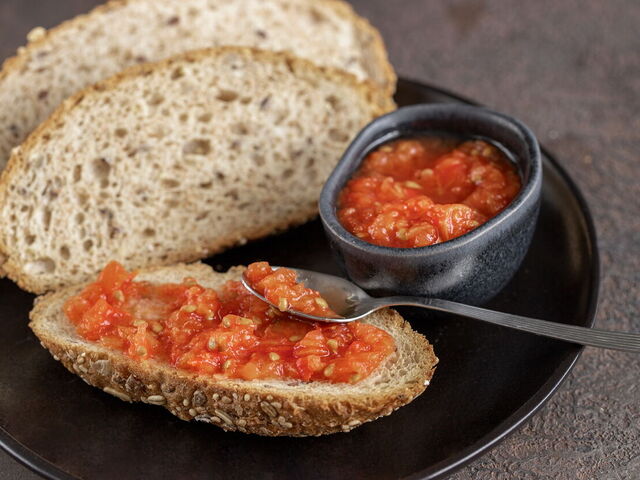
The village itself is very calm, and also known for its Pan amb tomaquet, or bread with tomato, which you can eat at the bars or various terraces in town.
Santa Gertrudis de Fruitera is another spot not to be missed! Its church, built at the end of the 1700s, has a splendid white facade in characteristic Ibizan style, but with colorful touches. It is one of a kind!
If you would like to visit marvelous inland Ibiza and explore splendid, authentic villages that offer utmost relaxation, take a look at our Villas in Ibiza, like Villa Savonne, Can Pegaso Grande and Blakstand San Rafael.
Read More
October 22, 2020
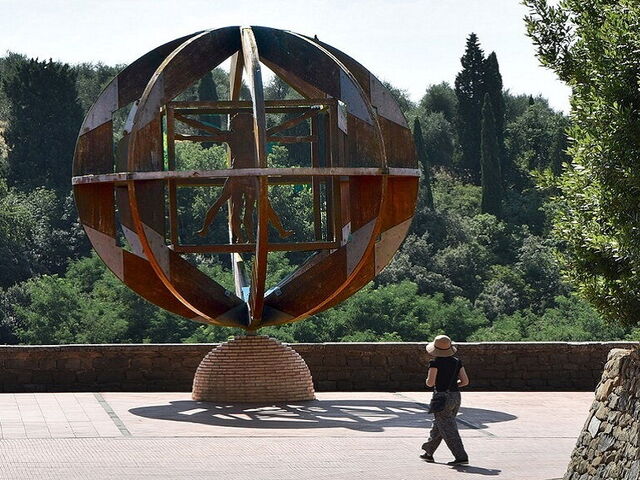
Leonardino Route: in the Footsteps of Leonardo da Vinci
Did you know that in the heart of Tuscany there is a wonderful nature trail that retraces the footsteps of Leonardo da Vinci?
Passing from Vinci, Anchiano and Montevettolini, which are the places where the artist spent his life, the Leonardino path was inspired by a drawing made by Leonardo in 1473, which depicted a view from the oratory of Santa Maria della Neve in Montevettolini.
There are two paths: one is called "the high path" and passes through the Montalbano ridge for a total of 17 kms, while the "low path" crosses the marshy area of the Padule and continues for a total length of 19 km. Passing through some of the most beautiful places in the Tuscan countryside, these paths allow you to discover hidden beauties and landscapes which are often ignored by popular itineraries. Ideal for people of all ages, they can be covered by foot in 5-6 hours or by mountain bike in 2-3 hours.
Would you like to know more? Discover more about the Leonardino road and start organizing your tour following the footsteps of the Tuscan genius!
The first route passes through some places of great historical value. It starts from Anchiano, where Leonardo's birthplace is located: he was born here on April 15, 1452 and the house remained in the possession of his until 1624. The road then continues towards Sant'Amato, it crosses the "Path of the Ancient Mills" and the remains of a wall of the Barco Reale, which is the name of a construction commissioned by the Medici Family to protect the game of Montalbano. Then, you arrive at Costareccia, the place where one of the family properties was located, and continue towards Orbignano. In this small village there is the Church of Santa Maria al Pruno, which preserves a wooden statue of the Madonna which was found abandoned in the midst of brambles after a theft, according to a legend. The route continues towards Lamporecchio, where you can visit the Pieve di Santo Stefano and see the marvelous terracotta altarpiece from 1524, made by Giovanni Della Robbia. Later, the route passes through Larciano, a village dominated by the tower of a fortress, as well as through the medieval village of Cecina, finally reaching Montevettolini. In this locality, the Medici built a villa in 1597 that dominates the whole valley!
The second route best enhances the natural beauties of the place and starts from Anchiano to continue towards the Church of Santa Lucia, which is considered Leonardo's place of baptism. From here, it continue towards the Torre di Sant’Alluccio, where the saint created a hospice for pilgrims during the Middle Ages and where you can also enjoy a splendid view of Valdarno and the plain of Pistoia. On the ridge road, there is also the Abbey of San Baronto, which was an important stopping place for Medieval pilgrims. You will also come across the remains of the Barco Reale, a wonderful hunting bandit commissioned by the Medici between the 16th and 17th centuries, where the game was raised and kept. The wall was interspersed with gates and today it is still possible to see one of the floodgates used for the flow of water. It is a splendid place that should not be missed! Other places you must see are the church of Santa Maria Assunta in Faltognano and the 17th century Cappella del Barco, which are located near this path. Finally, you reach Montevettolini , where you can fall in love with the beauty of the Medici Villa.
Are you ready for your itinerary retracing the steps of Leonardo da Vinci? Book now one of our properties near Vinci, such as Nicola, Il Sole di Vino and Villa Nora, and get ready to discover the beautiful places of Leonardo's life!
Read More
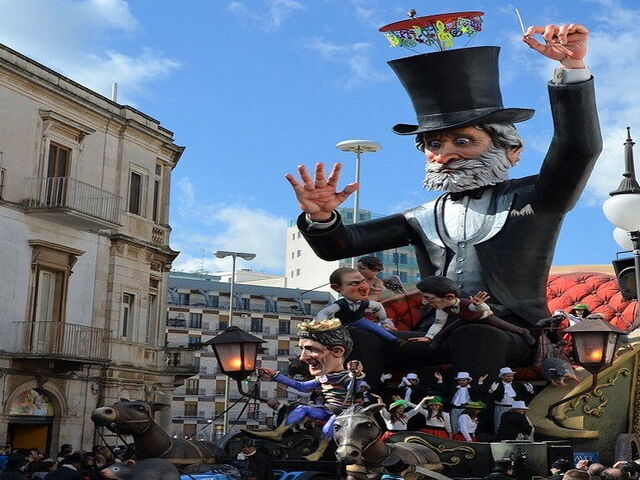
Did you know that the Putignano's Carnival festival is one of the oldest and longest in Europe? This year, the town celebrates the 626th edition and the theme is "The Earth seen from the Carnival".
If you are in Puglia, don't miss the opportunity to participate in this incredible event! Discover more about its history and find all the information you need to take part to it!
It all started way back in 1394, when Puglia was the aim of Saracen raids. To protect local treasures, some important objects, such as the relics of Saint Stefano in Monopoli, were brought to safety. The new destination was Putignano and the relics were transferred there on December 26, 1394. A legend tells that many peasants joined the religious procession singing festive, but also satirical songs. They abandoned their work in the fields to participate and they left the vines they were treating with a traditional offshoot technique.
This was, in fact, the beginning of "Festa delle Propaggini" (offshoot festival), which is still celebrated with passion after 626 years. Every December 26th, local poets recite their poems in the city's square, recounting the main events of the past year and ridiculing them in a satirical way. Actually, it is a challenge in vernacular language based on satire against local politicians: if you are in Puglia in late December, this is definitely an event you cannot miss!
"Festa delle Propaggini" officially kicks off the period of Carnival, which begins on January 17 with the Festival of Sant'Antonio Abate. Every Thursday, satirical shows are organized in the town and each one is aimed at a different objective. Monsignors, priests, nuns, widows, madmen, married women and cuckolds ... nobody is spared! The so-called "Festa dei Cornuti" (cuckold festival) is certainly the most fun: it begins with a procession at dawn where participants walk with large horns on their heads and it is followed by the proclamation of the "horned man of the year". In the evening, all the horns are cut to symbolize the erasure of the signs of betrayal. Another important date is the Bear Festival, celebrated on February 2, which is also the day of Candlemas.
The beautiful allegorical float parades take place every Sunday in February (9,16,23,25 and 29 February 2020). They include seven allegorical floats made by masters of papier-mâché, which represent facts of national and international importance in an ironic way. These works of art can also be admired with a closer look by visiting the sheds where they are created: it is a unique experience, suitable for the whole family! This year, the theme of the parade is the Earth, which must be protected through sustainable development and reducing environmental impact.
On the eve of Fat Tuesday, Putignano organizes another important procession attended by people dressed as priests, who impart extreme unction at the Carnival. Then, "his funeral" is celebrated on Shrove Tuesday evening: to symbolize the end of this period, a large papier-mâché pig is burned in the main square and the Maccheroni Bell rings 365 strokes to mark the beginning of Lent.
The typical mask of Putignano is Farinella , which takes its name from a product based on barley, chickpeas and salt cooked by farmers in this period.
What are you waiting for? Book a
Read More
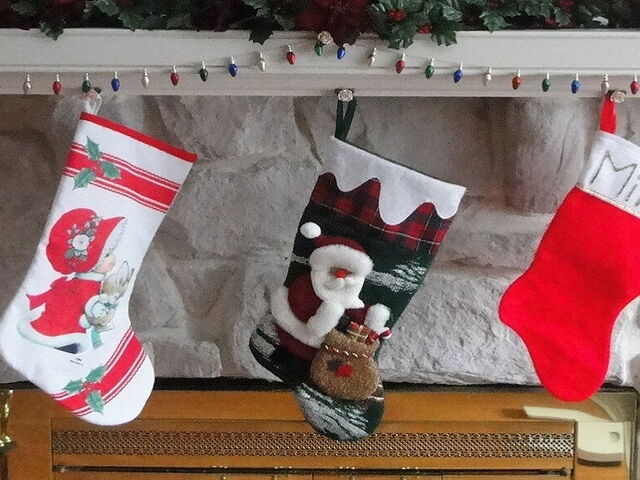
The word Epiphany literally means "revelation" and refers to the appearance of Christ to men through the Three Kings. So why do Italian children wait for the Befana to bring them chocolate and sweets on January 6th? What does an old lady who rides a broom mean?
Discover more about the history of Befana and all the unmissable events taking place around Italy to celebrate Epiphany!
According to a legend, the Three Wise Men on their way to Jesus's birthplace asked for information to an old woman, because they could not find the right path. To thank her for her help, they insisted to make her join their road, but she declined their invitation. However, the old woman soon repented bitterly of her decision and she quickly prepared a basket of sweets to bring to the newborn child. She went out to look for the three Men, but it was too late and she couldn't find them. So, she started knocking on the door of every house she found in search of Jesus, leaving sweets to every child she met hoping that he was Baby Jesus in person. And after more than two thousand years, that's what she's still doing!
On January 6th of each year, children sing a famous refrain waiting to receive sweets and other delights. The translation is: "The Befana comes at night with her shoes all broken, with the patches on her skirt: viva, viva the Befana!". This is how this old woman is represented by all kids. On the night between 5 and 6 January, she descends from the fireplace to fill the empty hanging socks left by children. The good ones will receive gifts and sweets, while the naughty will find some awful coal!
Each Italian region celebrates the Befana in a special way, organizing markets, traditional festivals and some typical auspicious stakes, as it represents that the past year is "burned" to make room to the new one.
In Tuscany, in the province of Grosseto, there is a group of boys called "befani", who accompany the old woman through the streets of the city singing some songs. In Florence, the so-called "Cavalcade of the Three Kings" is organized every year: this is a procession consisting of about 700 figures leaving from Piazza Pitti, crossing the entire historic center and arriving at the Baptistery, simulating the journey of the Wise Men to Bethlehem. Moving to Lucca and its surroundings, we suggest taking part to the Befana celebration in Barga, where Epiphany is deeply felt: the children disguised as a Befana move from house to house singing songs and finally gather around a bonfire forming a large circle. In the locality of Pegnana, there is also a small Befana house that can be visited at any time of the year.
In Liguria the Befana comes from the sea making every child very joyful, while the most famous Epiphany market in Lazio is located in Rome in Piazza Navona, where a Befana in person comes to greet the children among stalls full of sweets. The streets of Naples, on the other hand, are full of markets where you can buy sweets for stockings, especially in Piazza Mercato.
What do you eat on this special occasion? Tuscan tradition includes Cavallucci of Siena, which are soft biscuits made with water, sugar, honey, candied fruit, anise, nuts and yeast, as well as "Befanini", which are cookies coming from the Lucca area made with rhum and citrus fruits.
In Liguria, people prepare the "anicini" biscuits, usually eaten with a glass of sweet wine, and the donut of the Three Wise Men , a dessert covered with raisins, candied fruit and sugar. In the south of Italy, precisely in Campania, people prepare the first pastiera of the year and some delicious struffoli, which are small balls of sweet fried dough, dipped in honey and decorated with candied fruit and sugared almonds.
© Alice Pilastri
Read More
Choosing Tuscany as your New Year's Eve destination is an excellent idea! Whether you are a group of friends, a young couple or a family with children, spending the last day of the year in this region guarantees fun and unforgettable moments to all.
There are hundreds of different ways to celebrate New Year's Eve in Tuscany: what's your favorite one? Find the one that best satisfies you and make your wishes come true!
All the most beautiful arts towns in Tuscany offer the opportunity to celebrate 2020 taking part to special open-air events. The main squares of cities like Lucca, Siena or Pisa organize concerts and festivals, surrounding visitors by frames of unique beauty . Along the streets of Florence, shows, entertainment and concerts offering various music genres are held all night long to entertain people. In addition to walking among the illuminated monuments, don't miss a visit to Piazzale Michelangelo, Piazza della Signoria or the Oltrarno, which all offer some wonderful atmospheres!
The city of Siena also offers some great events in the heart of the city, called Piazza del Campo. Open air performances, small concerts and an unmissable "silent party" are some of the fantastic events organized every year, as the city of Palio always manages to amaze its visitors!
Moving along the coast, Versilia is the location of incredible celebrations in its famous discoclubs and on its "Lungomare" promenade. In fact, Viareggio is not just a famous seaside resort, but also an exclusive winter destination with an enviable nightlife. While the youngest are attracted by its liveliness, families can enjoy other beautiful attractions such as the seafront promenade with cafes, fashion store and excellent restaurants. If you'd like to spend a day having shopping, you can also go to Forte dei Marmi, that offers countless luxury places to spend the most spectacular night of the year!
And how about going to the mountains instead? The beautiful snowy peaks of Abetone, Monte Amiata or Lunigiana are perfect if you'd like to enjoy some downhill skiing or a rich dinner in a high mountain refuge!
Instead, lovers of tranquility can spend a wonderful New Year's Eve in a lovely countryside village. Their countless facilities and delicious local restaurants will allow you to celebrate it in the best way! In addition to the famous region of Chianti, the areas of Val d'Orcia and Maremma also have nice towns where couples can organize a short romantic getaway, surrounded by landscapes of rare beauty.
And finally, don't forget to consider a New Year's Eve in a SPA! For a relaxing December 31 away from the chaos, we suggest you go to wel--known destinations like Montecatini Terme , in Rapolano, Chianciano or Saturnia. It's definitely a great idea to start the year putting well-being in the first place!
So whether you travel alone or in company, whether you prefer to have fun or rest, Tuscany is certainly the ideal destination to spend your New Year's Eve.
Have you booked a holiday home for December 31st? Discover our selection of villas for rent in Tuscany and choose the one that suits you best to spend an unforgettable New Year!
© Alice Pilastri
Read More
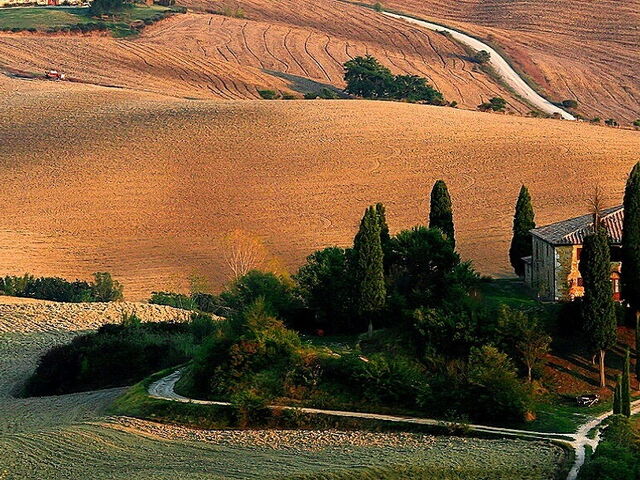
Autumn is definitely one of the best seasons to visit Tuscany! The temperature is milder, crowds of tourists have decreased and you can peacefully visit the beautiful cities of art enjoy an absolute tranquility. And, above all, in this period you can admire some wonderful natural country landscapes, as Tuscany lights up of some magnificent colors! Actually, September, October and November are the months that can make you fully enjoy the beauties of this region, also giving you the opportunity to participate in some unmissable events!
Have you organized a tour of Tuscany in fall? Discover all the things you need to do, the must-see places and some unmissable activities that will turn your trip into a daydream!
The first thing that comes to mind when thinking about Autumn is certainly a collection of beautiful colors. One of the most beautiful things to do in Tuscany is to admire the magnificent shades of Casentino National Park, especially if you love nature and its magical atmospheres. In this season, trees are tinged with unique colours and offer some breathtaking views you really don't want to miss. The Park is very extensive and the summit of Mount Penna, its highest spot, reaches 1000 m above the sea level. While visiting the Park, we recommend taking the road to Camaldoli hermitage and exploring the forest surrounding the Sanctuary of La Verna, as these places are surrounded by a mystical, surprising aura. In case you are travelling with children, you can also take the opportunity take part in some interesting workshops or to a wonderful night excursion in search of the deer that inhabits these woods!
When you think of autumn, however, people also immediately think about the harvest! Tuscany's vineyards are one of its best-known symbols and the Chianti region (between the provinces of Siena and Florence) is a real natural paradise where an excellent red wine is produced. There is nothing better than driving a car along the roads winding through vineyards, olive groves, lovely villages and medieval castles to enjoy the beauty of this area! Once you are in Chianti, you can easily reach Val d'Orcia, Val di Chiana or the wonderful vineyards of Maremma, where the famous Morellino di Scansano red wine is produced. In fall, many Tuscan villages also organize events and festivals dedicated to their new oil or wine, where people can taste a large selection of local delicacies: it's something you must include in your tour!
That's not all: another seasonal product is chestnut, a fruit cooked in infinite different ways in the coldest months! In Tuscany, there are two very popular areas of production of chestnuts. The first is Mugello, precisely in a town called Marradi where a famous chestnut festival has been held for more than fifty years. In October, dozens of gastronomic stands and delicacies of all kinds fill the streets of the city center, offering visitors a selection of unique and authentic flavors. The second one is the region around Mount Amiata, a mountain in Maremma. A trip in this part of Tuscany will include stops like Piancastagnaio, Castiglione d'Orcia, Abbadia San Salvatore and Castel del Piano, which are some lovely typical towns where chestnuts and mushrooms are simply delicious.
And finally, autumn means truffle and a visit to the medieval village of San Miniato! Every year, this town in the province of Pisa hosts an internationally renowned market exhibition dedicated to the local white truffle. Don't miss its excellent tastings and menus, which you can also taste inside one of its charming restaurants!
Haven't booked a house for your holiday in Tuscany yet? Check out our selection of villas, apartments and luxury properties in the region to book your favorite one!
© Alice Pilastri
Read More