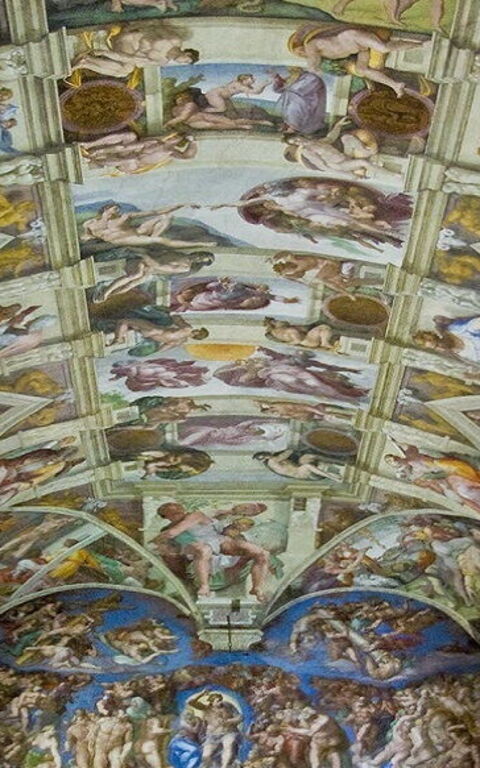

It is one of the must-sees of Rome, a masterpiece of Renaissance art, one of the most important Christian places and the most magnificent work by Michelangelo. We re talking about the Sistine Chapel, a stunning hall built next to St. Peter’s Basilica hosting Pope’s conclaves since the 15th century.
Let the colorful frescos take your breath away and organize your visit to spend some unforgettable moments surrounded by pure beauty!
The opening of the Chapel dates back to 1483, under Pope Sixtus IV. In the following years, artists like Pinturicchio, Ghirlandaio, Cosimo Rosselli and Botticelli painted the middle tier with the “Stories of Moses and Jesus” inspired by the Old and New Testament. Some of the scenes are “The Trials of Moses”, “The Temptations of Christ” or the famous “Delivery of the Keys” made by Perugino. The inferior tier presents a simple decorations with some fake curtains.

Another artist who worked in this site was Michelangelo, who received the commission from Pope Julius II in 1508 and concluded the project in 1512. His frescoes cover the whole surface of the vault, for a total of 1200 square meters.
The central scenes follow the iconographic project proposed by Egidio da Viterbo, who chose to represent the Stories of the Genesis in nine boxes. Each scene is framed by a fake marble architecture where four young “ignudi” are leaned on. The best-known among these is certainly the “Creation of Adam” portraying Adam in the act of touching God’s finger to be instilled by the Holy Spirit. The lateral scenes represent Sybils and Prophets, which are soothsayers of Christ’s arrival, as well as Jesus’s ancestors and some miraculous events in favor of Jewish people.
The beautiful bodies of the “ignudi” are some masculine nudes symbolizing humanity in its numerous forms of physical beauty. These figures have a great expressivity, they assume complex positions and they celebrate the most important divine creation, which is man.

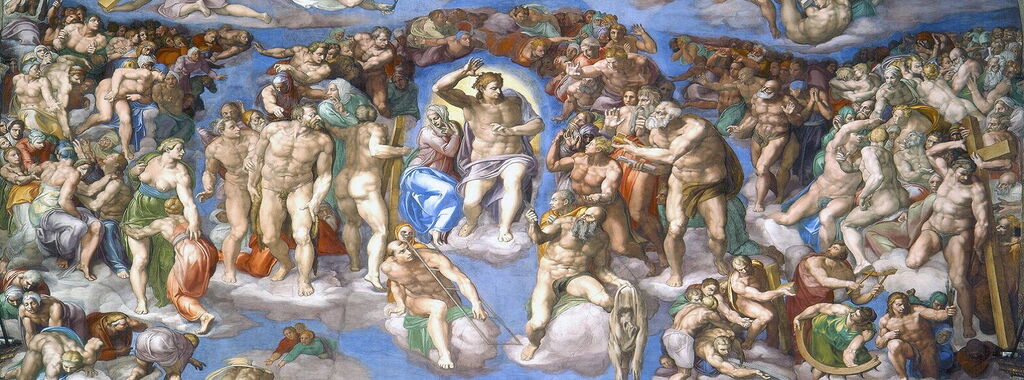
It was still Michelangelo who painted “The Last Judgement” between 1536 and 1541 behind the altar of the Chapel. In order to prepare the wall, the artist used a tilted bricks’ coverage to avoid the deposit of dust and to allow a better sight of the masterpiece from the bottom. He then chose to make a “good fresco” based on blue lapis which illuminate the work in a unique way. The azure background is crowded by many bodies which spin and circle around Christ. Inside the lunettes, the artist portrayed some angels with no wings who carry the symbols of Passion. The numerous figures have complex positions, intense facial expressions and a desperate pathos, especially in the case of the souls destined to Hell.
However, the fresco received a lot of critics because of the iconographic anomalies and the presence of too many naked bodies in a sacred place. Michelangelo’s justifications were of no use and, in occasion of the Council of Trento of 1564, an artist called “Braghettone” was charged to censure the scene covering all the naked bodies.
Visit the splendid Sistine Chapel! As it is part of the Vatican Museums, you will have the opportunity to buy a ticket that also allows you to visit its wonderful halls. The full-price ticket costs €17, the reduced ticket costs €8 and there are discounts for students, schools, pilgrims and families.
Do not forget to have a look to our properties in Rome and choose your favorite!