Archive for "Dream Places"
Planning a trip to Italy? Browse and read our useful and informative articles about the endless range of attractions and experiences in this lovely country.
Travel through the beauties of Italy with us. Visit our blog!
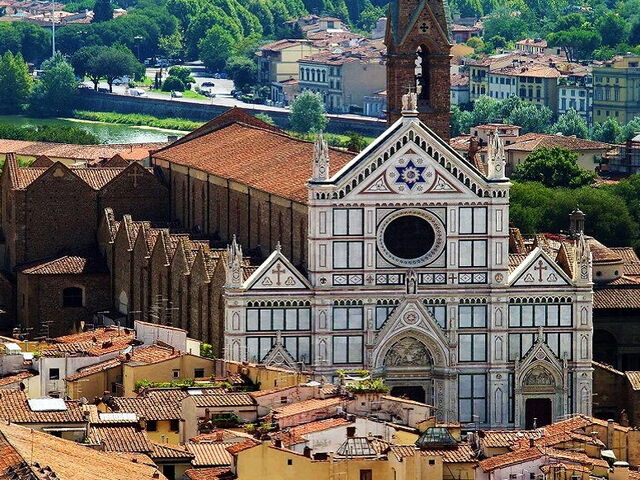
Walking along the narrow street separating the majestic stone wall of Palazzo Vecchio and the Uffizi Museum, you will soon arrive at Piazza Santa Croce and at its stunning Basilica.
The church is one of the major examples of Italian Gothic art, it was built in the 13th century by Arnolfo di Cambio and its façade was finished in the 19th century. It is a Franciscan basilica presenting an Egyptian/ Tau cross floorplan with three naves decorated by chapels and beautiful frescos. Among these, you will be able to look at Agnolo Gaddi's works in Cappella Maggiore, Giotto's frescos in Cappella Peruzzi and Cappella Bardi, Giovanni della Robbia's terracottas or Donatello's "Annunciazione Cavalcanti".
The Basilica di Santa Croce is known also as the "Temple of the Italian Glories" or the “Pantheon of Artists", because it conserves the remains of some of the best-known personalities of Italian history. Its peculiar graves are everywhere: some are located in the wonderful chapels along the naves, while many others fill up its pavement and make it possible to walk above them.
Until the beginning of 1400s, Santa Croce was principally the sepulchral church of district's families like Bardis, Peruzzis or Albertis. Things changed when the town government decided to build some elaborated funerary monuments for its chancellors Leonardo Bruni and Carlo Marsuppini. The two tombs were sculpted by Bernardo Rossellino and Desiderio da Settignano. These authentic masterpieces of Renaissance sculpture launched the new destiny of the Basilica, which became the solemn custody of Florentine public glories.
In 1564, the remains of Michelangelo were moved to Florence to be exposed in Santa Croce Church in a stunning monumental grave designed by Giorgio Vasari. Later, even the sepulchers of Galileo, Machiavelli, Foscolo, Rossini and Alfieri were erected inside the Basilica.
It is believed that Alfieri visited Santa Croce Church in order to find inspiration, as its wonderful sepulchers instilled a profound sense of peace. Another famous author, Stendhal, entered the church and felt a sudden illness because of the excessive quantity of memory conserved there, while Foscolo celebrated it in his work "I Sepolcri”.
What are you waiting for? Visit this Church and discover the indescribable emotions it will be able to give you! Along Via de'Neri, you can also stop at the famous “All’Antico Vinaio” sandwich shop or at “Gelateria de’Neri”, one of the best ice-cream parlors in Florence.
If you are looking for a property for your stay, choose our wonderful vacation rentals near Florence, like Le Fonti or Villa Tenuta Lonciano.
Read More
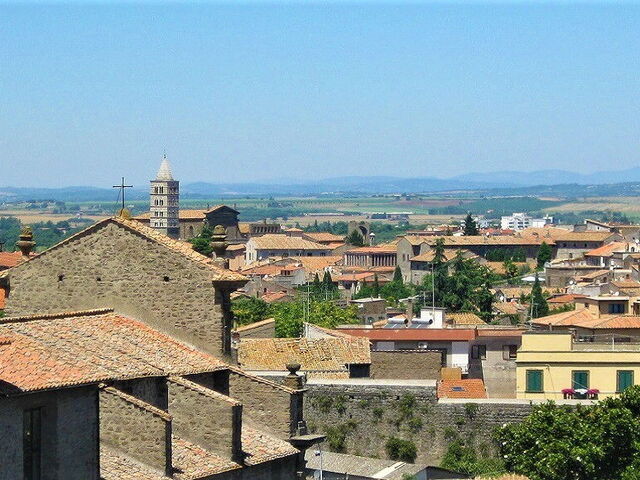
Travelling along the wonderful Via Cassia from Montefiascone, passing near some mountains and vulcanic lakes, you will reach the charming city of Viterbo, the ancient capital of Etruscan Latium. We are in the area between Mount Cimino, Vico Lake and the endless woods of chestnuts and conifers that surround the slight city slope.
Viterbo is a province in Northern Latium with centuries-old origins and buildings in its huge city center. There are many archaelogical itineraries offered to visitors in order to discover the historical heritage of this town, which is also the location of the peculiar “Macchina di Santa Rosa” celebration every September 3rd. In honor of the patron saint, an enormous illuminated structure is carried on the shoulders of one hundred “Facchini di Santa Rosa” along the streets. UNESCO even declared this event an “Intangible World Heritage”.
This city of "beautiful women and fountains” experienced its most flourishing period betweenin the 12th-13th century, when it became the so-called “city of the popes”.Three popes were buried here, six took shelter or inhabited the city durably, while six other were elected in its churches. In occasion of the designation of the last one, the French Martin IV, the people of Viterbo invaded the Dome and kidnapped two cardinals, so they were excommunicated and no Pope returned to the city for the following 86 years.
Viterbo still conserves a charming medieval aspect and there are many monuments or places of interest you cannot forget to visit during a stay here. The most beautiful part of it is the district of San Pellegrino, where small houses alternate with medieval towers in a labyrinth of streets, squares, stairways and stunning arches.
You should also see Palazzo dei Papi, a Romanic-style building with the magnificent "Salone del Conclave" where cardinals gathered from 1268 to 1271 to elect Clement IV successor. As they couldn't agree on his name, the People's Captain ordered to shut them in the building and to remove its roof, in order to encourage them to hurry up in their decision. Other important monuments are San Lorenzo Dome, built in the 12th century on the ruins of a Pagan temple dedicated to Hercules, Santa Maria Nuova Church, one of the oldest of the city with a beautiful pulpit, Santa Rosa Church, San Martino al Cimino Abbey or San Silvestro Church.
The museums that we suggest visiting are the Museo Civico and the Museo Colle del Duomo, conserving some beautiful sacred art masterpieces and acrhaelogical findings dating back to villanovian and medieval periods.
Visit this wonderful town during your next holiday in Latium! If you are looking for the perfect property to book for your stay, we propose our holiday rentals "I Gigli di Bolsena" or "Rielli Apartment", which are located a few kilometrs away from the city.
Read More
September 5, 2017
The Boboli Gardens, a Wonderful Open-Air Museum in Florence
Florence is famousin the whole world for the beauty of its architecture, its art, its numerous museums and its ancient buildings. There is also a well-known open-air museum between its streets, behind the stunning Palazzo Pitti: the “Giardino di Boboli”.
The history of the Garden begins in 1418, when Luca Pitti bought the land to build his palace. Some say that the name “Boboli” derives from the name of the family who owned these property before, called “Borgolo”. The transfer of ownership occurred in 1549, when the Medici family bought the Palazzo and commissioned the Garden realization to Niccolò Tibolo and Batolomeo Ammannati, who succeeded him after his death. Works continued under the Lorena and Savoy families, who adapted the late-Renaissance style to their historical period, adding some contemporary stylistic features. The park was then opened to the public by Pietro Leopoldo di Lorena and it was designated as UNESCO World Heritage in 2013.
It is a historical city park covering 45000 square meters. It’s the biggest, most famous and important example of “Italian Garden” and it has four public entrances (Cortile dell’Ammannati, Forte del Belvedere, Porta Romana, Piazza Pitti).
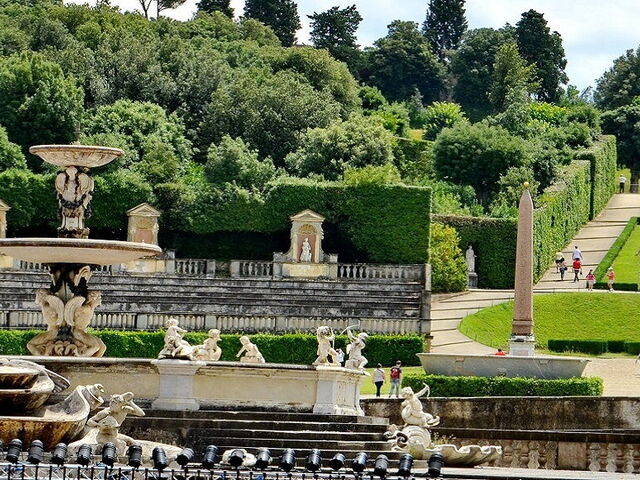
The Garden Is structured on two axes and it contains boulevards, statues, fountains, mannerist masterpieces, century-old trees, labyrinthic streets immersed in the vegetation and beautiful ancient buildings. One of its parts is the Amphitheater, an ancient stone mine that presents an Egyptian obelisk in its center. Here, you will find the “Bacino di Nettuno” and the fountain built in 1637, called “la Forchetta” (“the fork”) by Florentines. The street connecting the terraces until Porta Romana is called “Viottolone” and its tunnel made of weaved holm oaks creates a really magic atmosphere. In the Garden, you will also be able to see the “Prato del Cavaliere” designed by Michelangelo, the “Grotta di Madama” by Tribolo, the Medicean “Limonaia” and the “Kaffeehaus”, an 18th century structure pained in Lorena's symbolic light-green color.
The most charming spot of the park is probably the “Grotta del Buontalenti”, built in 1583-93 by Vasari and Buontalenti. It’s a three-room space richly decorated with stalagmites, frescos, stalactites and statues. Further to fountains’ water games, the grotto used to contain a large basin with many fishes in it. The first room recreates a natural ambience with many animal sculptures and it also hosted Michelangelo’s “Prigioni”, now conserved in Accademia Gallery. The second room contains Vincenzo de Rossi’s statues portraying Paris and Hellen while the third, darker room presents Giambologna’s “Venus”. The general decoration theme is the secret love meetings between Grand Duke Francis I and his lovers. The artistic style is Mannerist, as it’s based on the fusion between artificial and natural features.
What are you waiting for? Plan your visit to Boboli Gardens! The full ticket costs 7€, the reduced-price is 3,50€ and entrance is free for under-18s. The Garden is open every day from 8am, but we suggest checking opening hours on the official website, as they vary from month to month.
If you are looking for a property to rent for your stay in Florence, visit our website and look at our beautiful Villa Ancora!
Read More
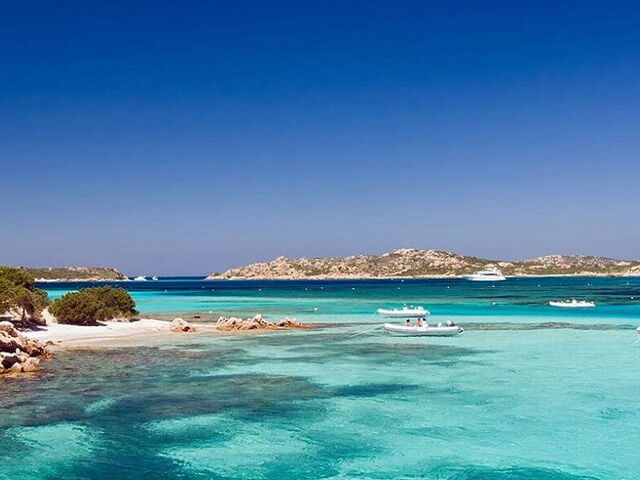
A wonderful destination for your next trip is certainly La Maddalena, the biggest of a 62-islands archipelago in Northern Sardinia formed by the well-known Budelli, Spargi, Santo Stefano, Razzoli and Caprera. La Maddalena is located right in front of Palau and of our charming Villa Sole tra i Ginepri, a luxury vacation rental on our website!
This 50 km² island presents sweet green hills and a jagged coastline with many coves and bays. The sea is transparent and there are innumerable natural beauties, more than 700 vegetal species and a rich marine fauna. The park authority safeguards this environment and it doesn’t allow the access to some splendid beaches to protect them, like the “Spiaggia Rosa” (Pink Beach) on Budelli island. Here, tourists used to take the pink sand home and this magic environment was risking permanent damages. Visitors can still visit beautiful beaches such as Bassa Trinita, Splamatore, Abbatoggia, Punta Tegge, Cala di Testa del Polpo beaches and the “Spiaggia del Relitto”, where a boat bobbed after a fire.
The must-see places are numerous: we suggest spending a day visiting the Compendio Garibaldino and the Memoriale Garibaldi on Caprera island, where Giuseppe Garibaldi arrived in 1857 and decided to spend the last years of his life. You can visit the barn, the private house and the spot where he and his daughters were buried. Furthermore, these islands offer an interesting museum tour between the “Museo Diocesano”, the “Museo del Mare” and “Museo Geomineralogico”, as well as a lot of sea and land summer excursions.
The first settlements on La Maddalena island date back to Neolithic Age but it was abandoned until the 18th century, when it became an important military objective because of its strategic position. This is why many defensive (like the “Forte San Vittorio”) and mimetic buildings were erected, in order to protect the island from sea and the following 20th century air attacks. Dedicate a day of your stay to the visit to granite quarries as well, where a high-quality granite is extracted and used to make famous sculptures, like Suez Canal Monument.
La Maddalena guarantees a holiday of relax, natural beauties and even a lot of fun. La Maddalena city center truly offers many entertainments to its visitors, with dozens of cafés, fish restaurants, clubs and shops.
To get to this island, you’ll need to board a ship in Palau and, once you’ll arrive, the splendid panoramas and maritime landscapes will certainly make your stay unforgettable!
Read More
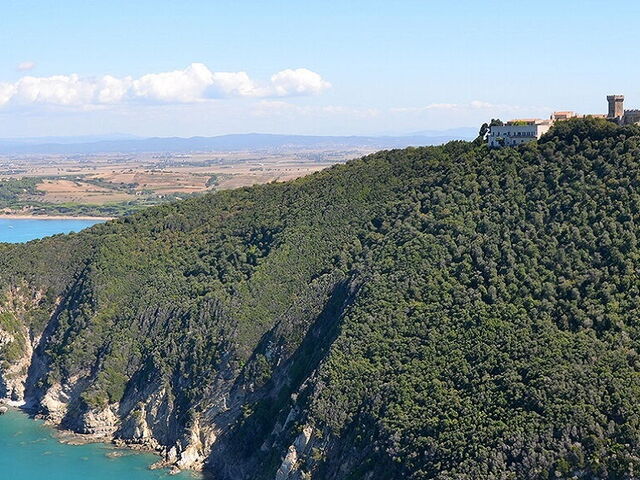
Tuscany is a region of a thousand beauties with some amazing beaches, especially in the area near Livorno and Grosseto. One of these is certainly found in the Gulf of Baratti, near the city of Piombino. This strip of sand separates a crystalline sea and a verdant promontory and it has a peculiar reddish color, due to the presence of iron minerals in the soil. It's the perfect destination for families with kids, couples, groups of friends and even for animals, as their admitted in a small trait of the beach. The water is transparent, the sea bottom is shallow and the surrounding panorama is breathtaking.
Actually, Baratty is not only famous for its beach, but also for its thousand-year old history linked to Etruscan civilization. The close center of Populonia became one of Etruria's most important centers between IX and VI century BC. The proximity to the sea was fundamental to undertake a commercial activity based on metalworking. Later, Populonia allied with Rome and therefore there are many architectural remains attesting its influence, like ruins of mines, industrial sections and necropolises.
Many of these graves are located in the "Parco Archeologico di Baratti e Populonia", an area of 80 hectares reachable through the path of Via delle Cave. Inside it, you will find ancient necropolises like those of San Cerbone, Casone or Poggio alla Porcareccia, dating back to VII-VI century BC. Noble families were buried all together in monumental tombs called “a tumulo” or “a edicola”, looking like small temples and internally decorated. On the other hand, a humblest and simplest type of tomb is “a sarcofago” or “a cassone”, which is individual and not decorated. Outside the park, you will find other ancient necropolises dating back to Villanovan period (IX-VIII century BC), like the one in "Buca delle Fate" or the necropolis of "Le Grotte", dug in sandstone.
So here's another stop of your journey across Tuscany, an ideal place to visit during your summer holiday! If you are looking for a vacation rental near Baratti, check out our luxury properties, like “Castello Leopoldo”!
Read More
Sicily is an emerged paradise from the Mediterranean Sea which shines with its numerous beauties. Palermo, Siracusa (which is the topic of one of our blog articles) or Agrigento are just some of the marvels you need to visit during your stay on the island. A part that you cannot miss to see is the region with Taormina and Giardini Naxos, in the province of Messina.
Taormina is a small but characteristic city on the coast in front of the Ionian Sea. It was founded in the archaic age and it was inhabited by various nations like Greeks, Romans, Arabs, Siculans and Normans. The fusion between different arts and cultures created a magic place, full of ancient buildings which are visited and appreciated by thousands of tourists. The best-known one is the Greek Theater, built in the III century BC by Greeks and renewed by Romans. This enormous and magnificent open space was used for dramas and plays during its Greek period, while Romans transformed it into an arena for gladiators’ fights or naval battles. It is the second biggest Greek theater in Sicily after the one in Siracusa and today it hosts suggestive music shows or important international events such as G7.
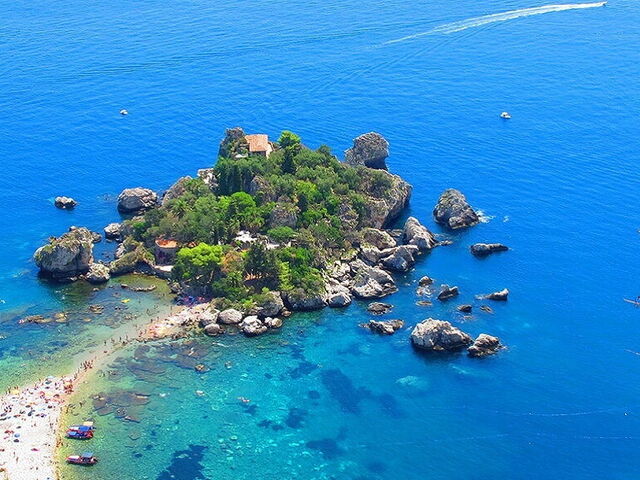
Taormina’s old town center is formed by hundreds of narrow streets with panoramic sea views. You can even enjoy the panorama on “Isola Bella”, a wonderful island linked to the city with a sand strip which disappears with high-tide. The rich vegetation, the transparent sea and the stunning “Grotta Blu” make this island a mandatory step of your visit! On the other hand, in the city center you will find other important ancient buildings like the “Neumachia” (a century-old Roman architecture), the 13th century Church-Dome, Casa Cuseni and the “Villa Comunale”, known for its beautiful garden. You also have to visit the amazing beaches, like Mazzarò, Spisone, Villagonia or those on the “Isola Bella”.
Even Giardini Naxos is a fascinating locality in Sicily located few kilometers away from Taormina. It’s the perfect destination for those who want a holiday of relax, culture and fun, as here you will find dozens of restaurants, pubs, nightclubs and cafés. Visit Alcantara waterfalls, the Medieval Schisò castle, the Archaeological Park and Museum, which contains many ancient findings. If you look for a beautiful beach to go to, we suggest Recanati, Schisò, San Giovanni or Porticciolo Saia.
The local specialties which will accompany you are numerous: taste the typical chocolate “granita”, the “brioche con cappello”, the delicious ice-creams, the “pasta alla norma” or a fish dish!
In order to enjoy your holiday to the fullest, we recommend participating to an important event like “Taormina Arte” or “Taormina Film Festival” and to book one of our luxury properties. Choose between “Taormina Suite”, “Villa la Boheme” and “Torre Isola Bella”!
Read More
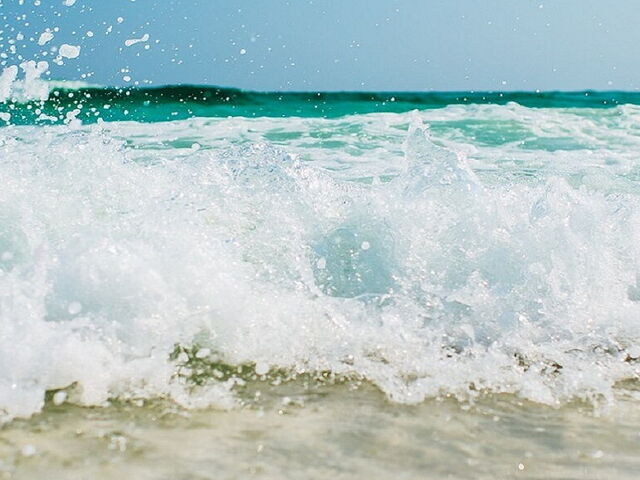
Elba Island is a small emerged paradise in the Mar Tirreno, belonging to the Arcipelago Toscano National Park a few kilometers far from Piombino channel. It’s the destination of millions of tourists, who depart from every corner of the globe to fall in love with its colors and sea. In its 147 kilometers of coastline, the island conceals beaches with rocks, pebbles, cliffs, fine or grainy sand. It invites elders, teenagers, couples and families to relax under its sun, to have fun in the nightclubs and to enjoy powerful emotions trying one of its numerous water sports. Elba island is a place to explore, to hike reaching the top of its mountains and to discover under water, swimming next to its fishes. Centuries of history are enclosed in this Italian atoll, which conserves traces of the Prehistoric Age, beautiful sanctuaries like the “Eremo di Santa Caterina” or elegant villas where napoleon lived during his exile. Further to its perfumes, its colors, its local flavors and its breathtaking panoramas, even its beaches give unique emotions to their visitors.
Therefore, I thought about creating my personal ranking list of the best beaches in Elba, to give some advices to the tourists who don’t know it well and only have one week to discover it. So here’s a top 7 of its beaches: one for each day!
1) FETOVAIA
Fetovaia is considered one of Italy’s finest beaches. It’s protected by a promontory covered by Mediterranean scrub and its crystalline waters are inhabited by a rich marine fauna. Thanks to the presence of cliffs, golden sand and waters with diverse depths, this place is suitable for all kinds of swimmers. It’s got all kinds of comfort and it ensures the maximum relax.
2) CAVOLI
The well-known Cavoli beach is made of white, grainy sand of a transparent sea looking like the Seychelles one. It’s 30 meters long, it’s found in a natural “Costa del Sole” bay and it’s easy to reach, thanks to the numerous road signs. There are also some equipped lidos and it’s indicated for families and young people who love the “movida”: actually, in summer people dance until sundown in the beach parties organized on the beach!
3) LACONELLA
You can reach this beach between Lacona and Capoliveri through a short uneven path. It’s suitable for families with children due to its shallow waters and it’s perfect for activities like snorkeling to observe its fishes. It’s made of golden sand and rocks of different dimensions, there isn’t any equipped lidos so it’s an entirely free beach.
4) BIODOLA
Biodola beach is embedded in a wonderful gulf and it presents 600 m of shiny sand: it’s considered the nicest beach of the island! The cliffs are the ideal place for sub or snorkeling, while the water waning make it suitable for children and families. This beach near Procchio has all kinds of comforts.
5) CAPO BIANCO
The stunning beach is made of white smooth stones and white, thin sand. The intense blue sea welcomes a beautiful wildlife which is perfect for snorkeling and it’s very easy to reach it. The beach is 290 m-long and it’s protected by high crags that protect it from the sirocco wind, guaranteeing calm and tranquility.
6) SANSONE
Portoferraio’s nicest beach is made of small pebbles and a wonderful sea with crystalline waters and a white sea bottom. On its right, a cliff allows to dive into this natural swimming pool, while on tis left there is a sea stack to practice kayak or canoe. The paradisiac beach is inhabited by hundreds of colored fishes, it offers a restaurant and many equipped lidos.
7) PADULELLA
This white beach on the northern coast is made of small smooth pebbles and it’s encircled by high white crags that protect it from northern winds. Being part of a protected natural area, its azure waters are full of marine fauna and they’re perfect for snorkeling. It’s easy to reach it from the principal routes and it ensures tranquility and quiet to its guests.
Read More
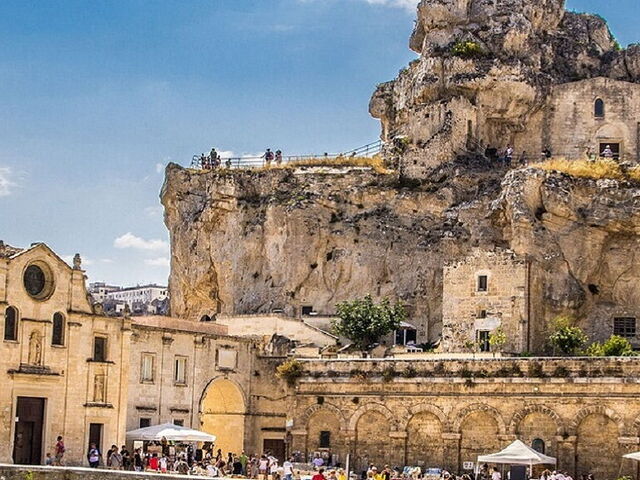
Some weeks ago I’ve been to Matera, a stunning city of Southern Italy in the region of Basilicata. Unesco awarded it as a “World Heritage Site” in 1993 because of the peculiar beauty of its “sassi” and it used the definition of “Cultural Landscape” for the first time. This city will also be the “European Capital of Culture” in 2019 and it will become the destination of thousands of tourists from all over the world!
The history of Matera is century-old and it started during the Paleolithic Age, whent the first inhabitants occupied the natural caves dug in the stone. More of them were added throughout the years, when man realized he could find shelter in the tuff stone excavating it. After overpassing the various pre-historical periods, Matera became a town of boundaries, contrasts and fusions between the different civilizations that dominated this area like the Byzantines, the Normans and the very important Christian populations.
Despite the historical changes, the famous Sassi have been inhabited ceaselessly. These houses have perfectly adapted to the natural context and men have discovered how to exploit the properties of their material and the constant internal temperature. Their structure is based on the superimposition of grottos, tunnels, houses, churches and gardens built in different epochs and they create a magic atmosphere with their dovetailing.
The Sassi are inserted in two huge natural amphitheaters called “Sasso Caveoso”and “Sasso Barisano”, which form the old town center with the “Civita” hill that divides them. The “Caveoso” is in the south, it presents many natural caves and it’s one of the richest Italian petroglyph heritages, while the “Barisano” is in the northern part and it’s mainly formed by excavated buildings.
Matera offers dozens of artistic and cultural events and the possibility to visit countless places of interest. An example is the wonderful Cathedral, built in 1270 in a Romanic style, or the “Parco Archeologico Storico Naturale delle Chiese Rupestri del Materano”, with several Paleolithic findings and churches like Santa Lucia delle Malve.
The uniqueness of its landscape has inspired some important writers like Carlo Levi, who wrote “Christ Stopped at Eboli” (1945) or film-directors like Mel Gibson, who filmed here his “Passion”(2004).
If you’re staying in Southern Italy or you’re looking for the ideal destination for a journey between natural, artistic and historical beauties, choose to visit Matera! Check our properties in Apulia, just a few kilometers away from the city!
Read More
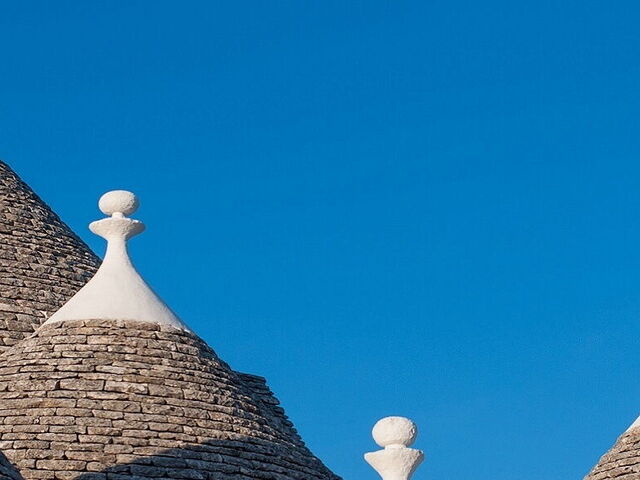
When we think about Apulia, we call to mind its sun, its splendid sea and its peculiar white buildings, the famous “Trulli”. It you visit this region, you cannot miss to visit Alberobello, the “capital of trulli” which has been awarded by Unesco as a “World Heritage Site”. This small center is almost completely made of trulli, which are white-grey cone-shaped stone buildings that follow one another along the streets. The atmosphere is really magic and fairy-tale. Some buildings have been transformed into restaurants, souvenir shops, private houses or even churches, like the Sant’Antonio “trullo-church”. The oldest buildings date back to the XIV century, when Robert of Anjou offered the land to the first Count of Conversano and the area got populated again.
But what are the “trulli” and what’s their story?
These buildings are made of a typical Apulian material and they resume the prehistorical “tholos” model , the typical Mycenean 1500 BC grave. The first “trulli” were built by Apulian farmers with the rocks they found nearby in order to use them as temporary shelters or houses. Their dimension was initially small but it enlarged with the passing of time, until it included more than one room inside. The diffusion of “trulli” was due to the split of the feudal lands, as it was necessary to build new shelters for every farm in the countryside. Nowadays, the places with more “trulli” in them have turned into famous touristic destinations: further to Alberobello, don’t forget to visit Locorotondo, Cisternino, Martina Franca and Ceglie Messapica in the Valle d’Itria and the Altopiano della Murgia!
Some of these trulli have even been converted into wonderful properties where you can sleep for a few nights: it’s an unforgettable experience that you must have at least once in your life! Take a look at Trullo Oak or ”Trullo Santo Stefano”!
Read More
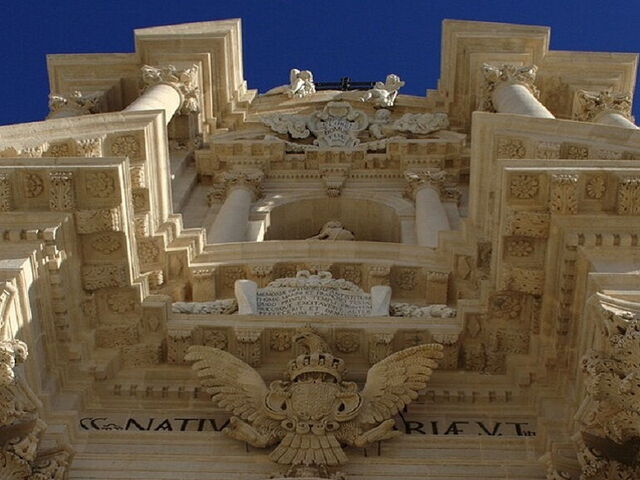
Syracuse is one of the most beautiful Sicilian cities, also famous for having a century-old history, a great artistic and archaeological heritage and for the stunning blue sea that distinguishes this Italian island. It was already a settlement during the Neolithic period, it hosted one of the oldest Christian communities and it has been occupied by Corinthians, Siculians and Arabs over the centuries. Since 2005, it is considered a UNESCO World Heritage Site and the presence of different kinds of ancient architectures in the same place contributed in transforming the city into a real Mediterranean jewel and an acclaimed touristic destination.
Here's a list of the spots you absolutely have to see in this wonderful city: don't forget to check our properties near Syracuse to choose the best accommodation for you stay!
• Madonna delle Lacrime Sanctuary
The building stands out from the other town center houses and it's visible from afar thanks to its 74 m height. It is considered a must-see in Syracuse by all its visitors and it was built in the 1960s after the lacrimation miracle of a chalk Madonna sculpture inside the church. Its dome has a peculiar aspect and if it's observed looking upward from the center of the building it is able to give a special sensation.
• Neapolis Archaelogical Park
This archaelogical park contains one of the biggest and best conserved Greek theaters (where it's possible to spectate to the acting of some classical Greek tragedies), a Roman amphiteater, the Altar of Lerone, the Latomie stone quarries and the "Ear of Dionysus", which is an artificial grotto linked to a famous legend. Visiting this place is like travelling through time: it's someting you really don't want to miss!
• The Catacombs of San Giovanni
Syracuse conceals the largest Italian catacombs after those in Rome, built by one of the first Christian communities of the Mediterranean. Explore the labyrinthine tunnels looking for the spot where it is believed that St. Paul preached to Sicilians!
•Ortigia>
Ortigia is the small old town center on a little island. Its narrow streets are overflown with people, typical local markets, delicious fish restaurants and many small shops. Its charm lies on the myriad of temples, castles and hidden churches, like the majestic Dome built over an ancient Greek temple. Walking along the seaside, you'll get to the Aretusa terrace, where an amazing panorama will take your breath away. Even the Maniace Castle, the "Bagno Ebraico" and the "Ipogeo" are places you really need to see.
• River Ciane
Papyrus plants are not only in Egypt as in this area they grow naturally. I suggest you a boat ride over river Ciane, where you'll be surrounded by hundreds of these plants and you'll have an amazing time. A whole museum is dedicated to this material, which is also used by craftsmen as a support for their watercolour paintings.
• Museo Regionale Paolo Orsi
This archaelogical museum is the biggest one in Sicily. In its halls you'll admire hundreds of findings coming from Sicily's excavations and magnificent prehistoric, Roman and Greek masterpieces.
• Santa Lucia Church
"Santa Lucia" is the town patron saint, as she was born here. Many churches are dedicated to her and the most important one is the "Chiesa di Santa Lucia alla Badia", inside of which there is a Caravaggio's masterpiece: "The Burial of S. Lucia".
• The Necropolis of Pantalica
In Pantalica, a village near Syracuse, there is one of the most valuable prehistoric sites, dating back to the XIII century BC. The necropolis presents over 5000 stone graves and the "Prince Palace", called "Anaktoron", on the top of the hill.
• The Sea and the Beaches
Syracuse is not just art, history and architecture: it's also full of wonderful natural landscapes and marvels! If the weather allows it, go to the beaches of Syracuse, Arenella, Fontane Bianche, Terrauzza or Ognina and dive into the splendid water. Remember to visit the Plemmirio protected marine area: it really deserves a glimpse!
Read More