Archive for "Wineries"
Planning a trip to Italy? Browse and read our useful and informative articles about the endless range of attractions and experiences in this lovely country.
Travel through the beauties of Italy with us. Visit our blog!
October 12, 2024
Montalcino: Brunello Wine, History and Art
Montalcino: A Journey Through History and Wine
Montalcino is a picturesque medieval town located on a hilltop in the heart of Tuscany. The town is known for its rich history, scenic landscape, and – not least – its world-renowned wine, Brunello di Montalcino. Visiting Montalcino is like traveling back in time while experiencing some of Italy's best wines and culinary delights.
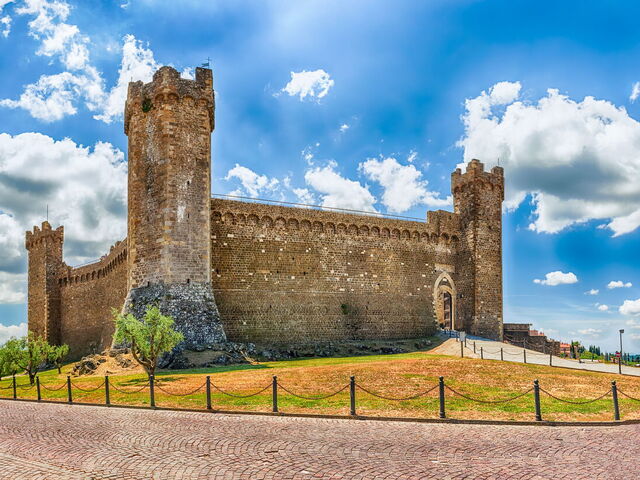
Montalcino traces its roots back to Etruscan times, but it was during the Middle Ages that the town truly flourished as an important fortified city in the region. In the 14th century, Montalcino was often at the center of conflicts between Siena and Florence, both vying for control of the strategically important town. Today, visitors can still see the well-preserved city walls and the fortress "La Fortezza," built in 1361, a testament to Montalcino's war-torn past. From the fortress, you can enjoy stunning views of the rolling hills of Val d'Orcia, a UNESCO World Heritage site.
Brunello di Montalcino – A World-Class Wine
No mention of Montalcino is complete without talking about Brunello di Montalcino, one of Italy's most prestigious wines. This powerful red wine is made exclusively from Sangiovese grapes, locally known as "Brunello." The wine production here is subject to strict regulations, and the wine must be aged for at least five years, with at least two of those years in oak barrels, before it can be sold. This gives Brunello its complex, full-bodied flavor with aromas of dark fruits, spices, and earthy tones.
Montalcino is surrounded by many renowned wineries offering visitors the opportunity to explore the vineyards and participate in wine tastings. Here are some of the most famous:
Biondi-Santi: This is the winery considered to be the birthplace of Brunello di Montalcino. Biondi-Santi has a long history and has been crucial in the development of the now world-famous Brunello wine.
Banfi: Castello Banfi is not only a winery but also a stunning castle. It is one of the largest producers in the region, known for its innovative approach to winemaking and a wide range of wines, including Brunello.
Casanova di Neri: One of the most prestigious wineries in Montalcino, Casanova di Neri has received many international accolades for its wines. Their Brunello has been recognized as one of the world's best wines by renowned wine critics.
Poggio Antico: Located at one of the highest points in Montalcino, this winery is known for its elegant Brunello. The estate offers guided tours that provide insights into both winemaking and the area's history.
A typical wine tasting in Montalcino often includes both Brunello di Montalcino and Rosso di Montalcino, a younger and lighter wine perfect for immediate enjoyment. Many wineries also offer guided tours, where you can learn about the entire production process, from grape harvesting to bottling.
Sights in Montalcino
In addition to the wine experiences, Montalcino also boasts many cultural and historical sights worth exploring. Here are some highlights:
La Fortezza: The old fortress, built in 1361, is an impressive sight and a must for history enthusiasts. From the top of the fortress walls, you can enjoy a breathtaking view of the surrounding landscape.
Piazza del Popolo: The town's central square, surrounded by medieval buildings, is a great place to experience Montalcino's charming atmosphere. Here you'll also find the Palazzo dei Priori, a historic town hall with a slender clock tower.
Sant'Antimo Abbey: Just outside the town lies this magnificent Romanesque abbey, dating back to the 8th century. It is said that Charlemagne founded the abbey, and it is known for its simple yet impressive architecture and the Gregorian chants often performed here.
Museo Civico e Diocesano: For art lovers, this museum is a must. It houses an impressive collection of religious art, including works from the Sienese school, which dominated the region during the Middle Ages.
Whether you're a history enthusiast, wine lover, or simply want to experience the beauty of Val d'Orcia in Tuscany, Montalcino has something to offer. The town's unique blend of culture, nature, and exceptional wine makes it an unforgettable destination.
Take your time exploring the cobblestone streets, enjoy a glass of Brunello at a local winery, and let yourself be charmed by the authentic Tuscan atmosphere that Montalcino has to offer.
Read More
You have arrived in Italy after a long journey. The Tuscan hills are holding you in their arms, the chirping of the sparrows cheers your last few kilometres and the light tramontana wind moves the olive branches pointing the road, everything is enlightened by an orange sunset reflecting on the windscreen of your car.
You are happy, you can't wait to get to the villa you have rented and take off your shoes, walk on the soft lawn to stretch your legs. The bravest will even dive into the pool.
It's all beautiful, but you realise you haven't thought about dinner.
This is where we come in, or rather, the libidinous Schiacciata Toscana.
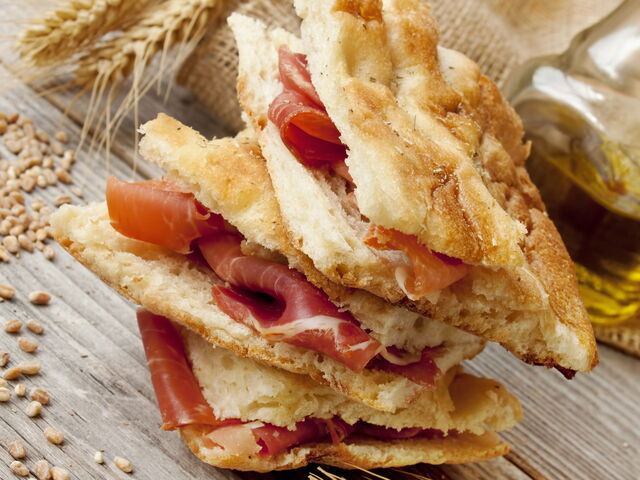
Ciaccia, schiacciata, stiacciata, schiaccia, in short, the typical Tuscan focaccia is a product of peasant cuisine and is known and appreciated throughout Italy.
The characteristics that must not be missing are
1. extreme crunchiness
2. large air bubbles
3. signs of hand pinching
4. an abundant brush with extra virgin olive oil after cooking.
Schiacciata (because that's what you'll have to call it when you order it) is one of the oldest Italian street food recipes and one of the most popular dishes among Tuscans.
Now you may be wondering how to stuff this food of the gods?
Schiacciata can be eaten in both savoury and sweet versions (no, we're not crazy, you'll see why).
The traditional stuffing of schiaccia is cold cuts and cheeses, and if you're feeling healthy or preparing for the swimming season, you can also add some vegetables. We recommend the combination of prosciutto crudo, Tuscan pecorino cheese and truffle cream, or Tuscan porchetta, parmesan cheese and roast potatoes, or if you're feeling more classic: schiacciata with mortadella.
But now let's move on to the sweet version: schiacciata with Nutella. This is the snack that every Italian child wants to find on his or her return home and that every adult secretly eats in the evening after dinner.
The savouriness of the salt crystals on the surface contrasting with the sweetness of the nutella helps to create what can be described as 'food porn'. In addition, it is as if the oil in the schiacciata and the fats in the creamy spread annihilate each other, creating a black hole in the stomach of those who eat it: one schiacciata alone will not satisfy your craving, you will need at least three! (we would like to point out that we are not responsible for the addiction that this food may create).
But where can you eat all this?
If you want to feel like a true Italian, our advice is to go and buy the schiacciata in any bakery and fill it to your liking. If, on the other hand, you prefer to leave it to an expert hand, our recommendations are: All'antico vinaio, La prosciutteria, I fratellini, Da Giotto, Cioccolateria Ballerini, Forno Becagli.
Would you like to try your hand at preparing this work of art? Book a cooking class in one of our villas.
Ps. Don't forget to accompany your meal with a good glass of wine, hydration is important.
© Rebecca Taizzani
Read More
Who hasn't drunk a glass of a good Chianti red wine at least once? It is almost impossible to resist to such a delight in Tuscany! This variety of wine is one of the famous enogastronomic specialities you can find in Central Italy and it is produced in a large territory between Florence and Siena.
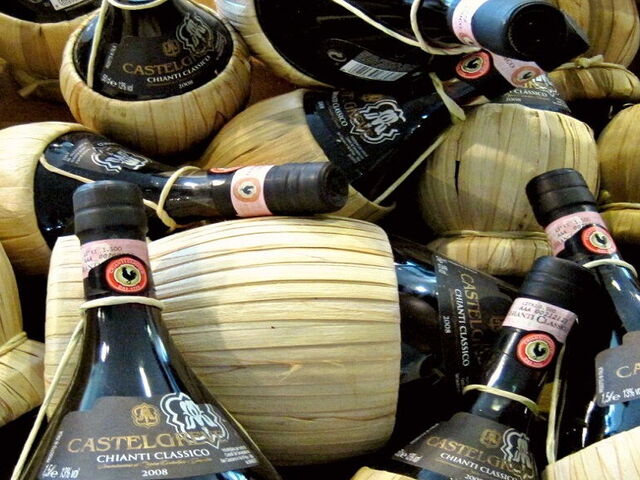
Maybe someone who was drinking it also noticed that on the neck of the bottle there is the figure of a black rooster in the middle of a yellow and red circle. And, who knows? Maybe he also visited the magnificent Salone dei Cinquecento inside Palazzo Vecchio on the same day and heard guide pointing out a specific detail on the wonderful ceiling that represented a black rooster inside a shield.
But then...what does this mean and where does this symbol come from?
The abovementioned fresco shows the ”Allegory of Chianti”, which is the name of a beautiful territory guarded jealously by the Florentines. The representation on the shield is the coat of arms belonging to Lega del Chianti , which was an important alliance between the cities of this region dating back to 1384.
In fact, the emblem of the Black Rooster has a mythical nature. In the Middle Ages, the Republics of Florence and Siena incessantly fought against each other and the main clash concerned the definition of the border between the two States and the control of the territory that separated them. After decades of battles, the two parties decided to cease the hostilities leaving the fateful decision to...two roosters.
They established a date and agreed that the first rooster to wake up and start singing would make its knight depart from the city he represented to race towards the rival town. The spot where the two knights would meet would establish the new definitive borderline between the two States.
Chance assigned a black rooster to Florence and a white one to Siena. Seneses began to take care of their "champion" with good manners, feeding it abundantly. On the other hand, Florentines adopted a different strategy and put the animal inside a dark cage, leaving few food to make it hungry and desperate.
As the D-Day dawn began, the black rooster exited the cage rapidly and started to sing loudly. His signal came to the Florentine knight, who began his horse race galloping for kilometers. Instead, the white cock did not want to leave the place where it had received all kinds of attentions and did not wake up before the sun had got up in the sky. When it sang, the Senese knight left his town but he couldn't fill the gap of time between him and his enemy. He ran for a bit more than 12 kilometers and met the other knight in a locality called Fonterutoli: the Florentine had arrived there after running for more than 100 kilometers! Here's the reason why the region of Chianti almost completely passed under Florence's control, a few years before even the city of Siena was conquered by the rival.
Since then, the grapes growing in this region would produce a type of wine called “Chianti”.
In 1716,the Grand Duke of Tuscany set the borders of the region of production instituting one of the first examples of "Denominazione di Origine Controllata"or DOC (registered designations of origin). In 1932, the “Consorzio Gallo Nero” was founded, but it changed its name to “Consorzio Chianti Classico” in 1992 because of the verdict of an American Court, which assigned the exclusive use of the name "Gallo" to identify a wine to the Californian Ernst Gallo Winery society.
So, here's the history hidden behind what is considered the best wine of the world!
Wouldn't you like to taste its unique flavor in one of the most charming locations ever? Then choose one of our Wine Tours in Tuscany or book a memorable holiday in Chianti with us!
© Alice Pilastri
Read More